‘Focusing on inner city’: Edmonton business expanding new market for old wood
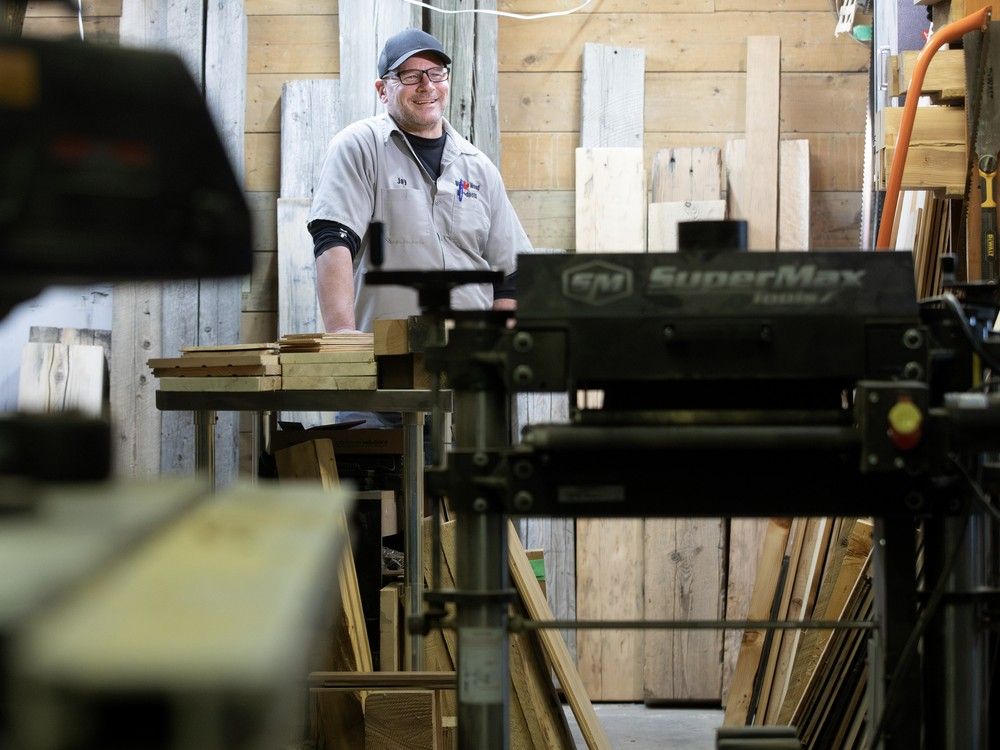
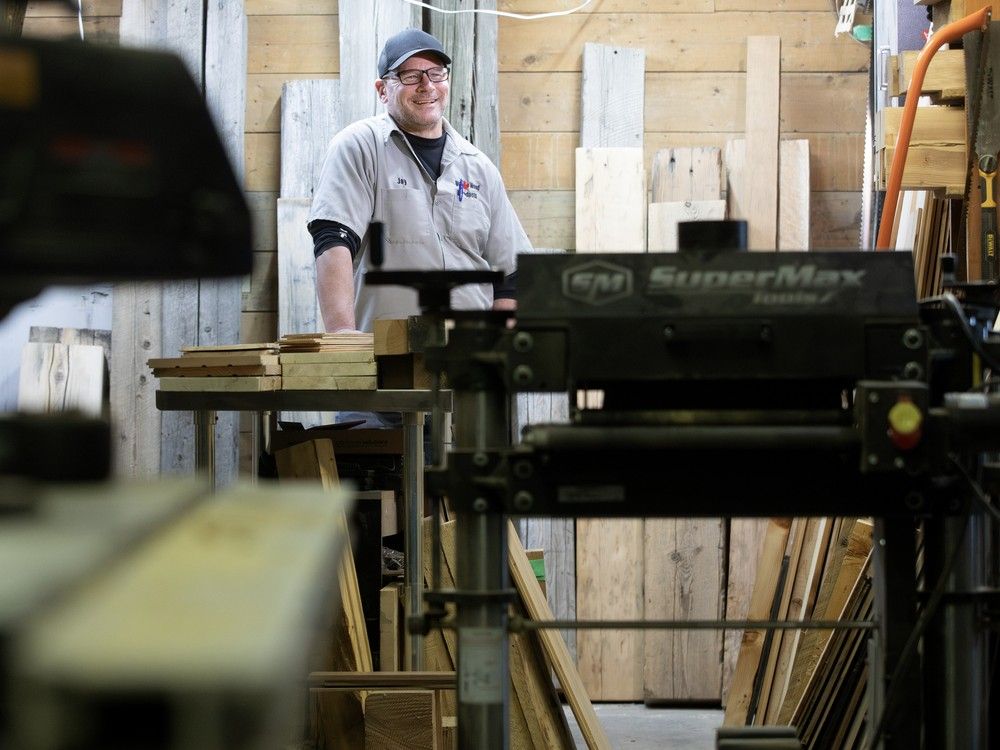
Whether gathered from Northlands stables, the city’s aging homes, or Fort Edmonton Park, an Edmonton business is giving the city’s old wood new life.
From tables to ceiling beams, artisans have long transformed reclaimed lumber into special pieces for homes and businesses, each imbued with a heritage touch.
But Jay Sanderson wants more of that wood put to better use. The
founder is working with local architects to set standards for reclaimed product, aiming to create a supply chain from construction and demolition for new builds.
“There’s tonnes of houses coming down in the inner city because of the densification initiatives. And so by focusing on inner city, there’s a budget to remove buildings and the quality of material that’s locked away in the inner city homes prior to 1960 is basically what we’re after,” Sanderson said.
Sanderson’s interest began when he helped a relative take down a barn and salvaged the wood. Now, instead of travelling the Prairies for old barn lumber, he finds what he needs in the walls of Edmonton homes being torn down.
Alberta’s construction and deconstruction make it ideal for Backroads, given the volume of wood waste produced.
While Sanderson values the artisanal market and sells some of his own creations, his bigger ambition is to scale Backroads in Edmonton — creating a space that goes beyond small-scale projects to industrialize and expand the operation.
Sanderson is establishing a system that he says will salvage wood at an industrial level, treat it, and return it back into the supply chain for future builders as new product from an old material.
Tonnes of wood burned after going to landfill
Kaia Nielsen-Roine, a PhD student at the University of British Columbia studying architecture, landscape architecture, and forestry, wrote her 2023 master’s thesis on wood waste in Metro Vancouver. She found that of 1.7 million tonnes of construction and demolition waste, the majority of materials headed for landfill was wood.
“Essentially, we produce a lot of wood waste, and very little of it gets used for any kind of value-added purpose. The vast majority of it goes to landfill. And if it is recycled, it’s all thermal recycling or hog fuel, so it just gets burnt for energy, which isn’t the worst recycling use, but it’s also the end of the line in terms of value,” Nielsen-Roine said.
Knowing how much wood waste there was, Nielsen-Roine wondered how it could be reused in construction. Her thesis, the “Seven Generations Wood Project,” was inspired by a sustainability principle that suggests people should be planning for seven generations when they build something.
Sanderson’s view is that if the building won’t stand for generations, perhaps the lumber still can. He says he wants to see old wood be a commercially available product that builders can source wherever they buy their lumber.
By collecting wood bound for landfill from construction and demolition at a Backroads facility, restoring it by resawing it, filling holes, and doing moisture and other treatments, Sanderson said the material is virtually as good as new.
His current shop does all this on a smaller scale, but he plans to get more equipment and space, allowing him to develop a bigger stock of reclaimed wood so that it can be used consistently by builders.
Backroads vice-president of branding and market development, Kirk Bentham, explained there’s more to the work he and Sanderson are doing than the product itself.
“We’re creating an infrastructure, and I would call it an inevitable infrastructure,” Bentham said. “We’re going beyond just creating a product for sale. We’re actually working with the municipal, the provincial and the federal governments to ensure that our product is specifiable. It has a name,” he said.
The name for their product is Specification-grade Recovered Lumber (SRL), but creating it, certifying it, figuring out a supply line for it has kept the two busy over the past year.
Demolition vs deconstruction
When Nielsen-Roine studied possible (re)uses of wood waste, she identified several hurdles.
Preserving wood during demolition requires careful deconstruction, which is costly and time-consuming. Nielsen-Roine says operators often pay higher landfill fees to dispose of mixed waste because it’s easier, making old wood harder to recover and giving companies little incentive to change.
Reclaimed wood is also known for its strength, coming from older trees that stood for longer than those used in modern commercial lumber. However, because it comes from a variety of structures, it varies in shape, size and quality, making consistent stock difficult.
Backroads is working with Edmonton architects to develop a standard that would certify the wood for commercial reuse after refurbishment. If successful, it would create a reliable, tested product for future builds.
SRL would also appear on SKUs for lumber retailers and on materials lists for architects, meaning the reclaimed wood can become a line item for a new project, rather than a special piece that would need to be procured from the existing fragmented reclaim market.
Bentham said the group is working to create inroads with policy-makers that would raise the costs of unseparated wood waste at the landfill to encourage operators to handle the material differently. It has also put forward the idea to deconstruct homes built in the city prior to a certain year, rather than to demolish.
Bentham pointed to the City of Portland, Oregon, which enacted a similar
in 2016. Initially, Portland restricted homes built in or before 1916 to be deconstructed to preserve the materials, but in 2020 the city upped the requirement for homes built in or before 1940.
Crucially, Sanderson explained Backroads is also working with
in Edmonton on the possibility of doing “panelized deconstruction,” which would allow him to get the waste wood, without extending the demolitions process.
“(All West) go in with some saws, and they cut the house into chunks, into panels. And then they drop them onto the back of a truck or into a bin, and they can move them off the site quickly. And then we do the deconstruction back at our facility,” Bentham said.
The process would maximize the amount of wood reclaimed, while not interrupting the construction process.
Growing facilities
The next few months of 2026 holds some big steps for the company.
Last year, Backroads was selected by Emissions Reduction Alberta (ERA) as a recipient of funding for the Advanced Materials Challenge, which supports the development of technologies and other solutions that accelerate the circular economy in the province.
ERA will match $1.98 million of raised funds from Backroads to help grow the business’ operations on an industrial scale. Sanderson said the group will be finishing fundraising in the new year, allowing for warehouse rental space big enough to house future operations.
As Backroads Reclamation prepares for its full launch in 2026, Sanderson said the group already has eyes for expansion into Calgary where he said there’s equal opportunity for better wood waste reclamation.
Related
Search Articles
Recent Posts
Stay Updated
Get the latest articles delivered to your inbox.